
KIAGS: Knowledge Island Agentic Game System
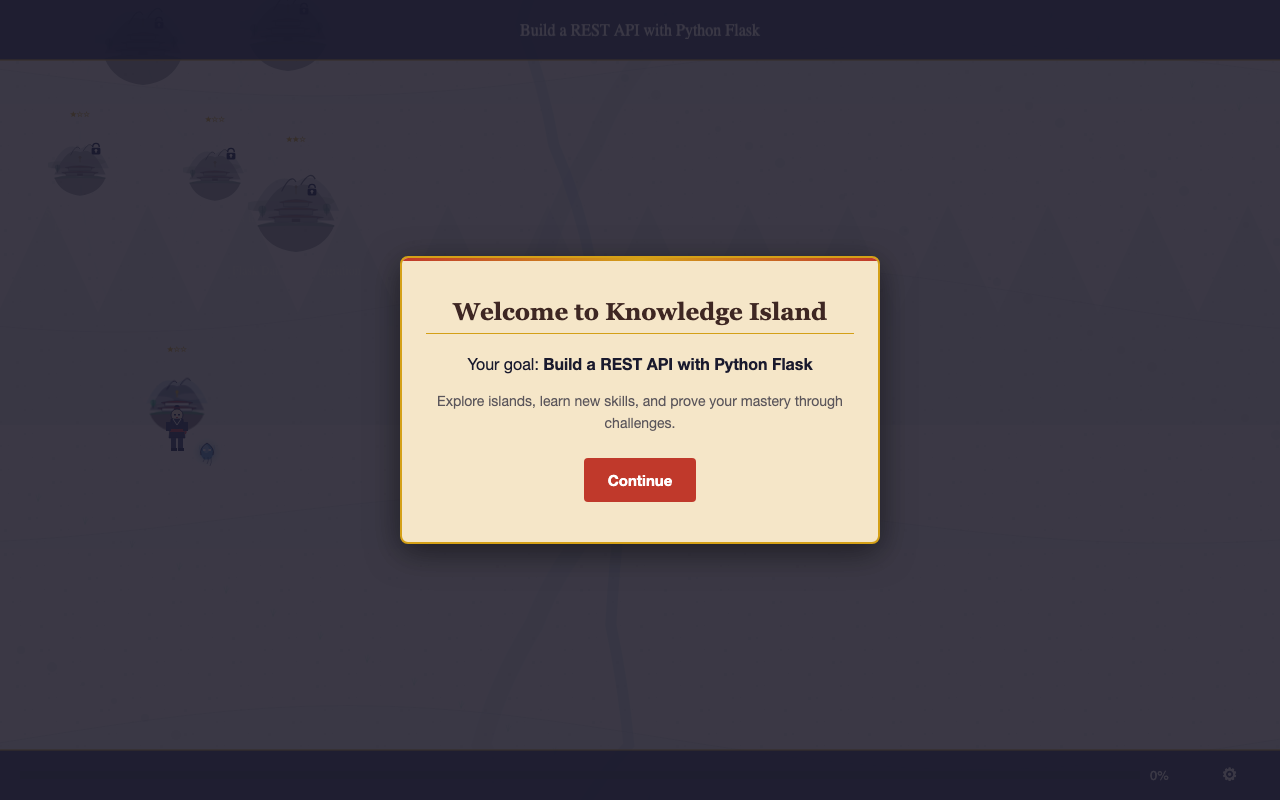
An AI-powered educational RPG generator that transforms any learning goal into a playable 2D island-exploration game
The Problem
Traditional educational games require months of manual content authoring for each new topic. Teachers who want game-based learning for their specific curriculum objectives face a stark choice: use generic off-the-shelf games that only loosely map to standards, or invest enormous resources in custom development. Neither path scales. Meanwhile, research consistently shows that well-designed educational games improve retention and engagement — the bottleneck is creation, not effectiveness.
Approach
KIAGS — the Knowledge Island Agentic Game System — eliminates the authoring bottleneck entirely. A teacher enters a plain-language learning goal (e.g., “Understand the causes and consequences of the American Revolution for 8th grade”) and the system autonomously generates a fully playable 2D island-exploration RPG.
The generation pipeline works in three stages:
-
Knowledge Graph Decomposition — An agentic workflow built on LangGraph orchestrates multiple calls to AWS Bedrock Claude to decompose the learning goal into a directed acyclic graph of knowledge nodes. Each node represents a discrete concept with prerequisite relationships, difficulty estimates, and assessment criteria.
-
World Synthesis — The knowledge graph is mapped onto an island overworld. Prerequisite chains become geographic gating: players must demonstrate mastery of foundational concepts before unlocking paths to advanced regions. Each knowledge node becomes an encounter — an NPC dialogue, a puzzle, or a challenge — with AI-generated question sets and contextual hints.
-
Asset Generation & Rendering — All game sprites, tilesets, and UI elements are procedurally generated via Canvas 2D at build time. There are no external sprite sheets or licensed art assets. The Phaser 3 engine renders the world, while a React 18 shell handles menus, progress tracking, and the HUD.
Key pedagogical features include progressive difficulty that adapts to player performance, prerequisite gating that enforces proper learning sequences, an AI companion that provides Socratic hints rather than direct answers, and spaced repetition encounters that resurface previously learned material at optimal review intervals.
My Role
I designed and built the full system end-to-end: the LangGraph agent architecture, the knowledge-graph-to-game-world mapping algorithm, the procedural sprite generation pipeline, the Phaser 3 game engine integration, and the React 18 application shell. I also designed the pedagogical model governing difficulty progression and spaced repetition scheduling.
Results & Impact
- Teachers can generate a complete, playable educational RPG from a single sentence in under two minutes
- Early pilot testing with K-12 students showed measurable gains in concept retention compared to traditional worksheet-based review
- The procedural generation approach means zero ongoing art or content licensing costs
- The system supports any subject area and grade level without domain-specific engineering
Technical Details
- Agent Framework: LangGraph for multi-step agentic orchestration with branching, retries, and human-in-the-loop checkpoints
- LLM Backend: AWS Bedrock Claude for knowledge decomposition, question generation, hint authoring, and narrative writing
- Game Engine: Phaser 3 for 2D rendering, physics, tilemaps, and input handling
- Application Shell: React 18 for UI chrome, state management, and progress persistence
- Sprite Pipeline: Canvas 2D procedural generation — characters, terrain tiles, items, and effects are all drawn programmatically with no external image assets
- Pedagogy: Directed acyclic graph traversal with mastery thresholds, adaptive difficulty via item-response-theory estimates, and spaced repetition scheduling based on learner performance history